
Discussing eye care, optometry, or vision
Discussing eye care, optometry, or vision.
The 👁️ Eye emoji represents vision, observation, surveillance, mindfulness, or keeping a watchful eye on something.
The 👁️ Eye emoji symbolizes sight, observation, and awareness. Unlike the playful double eyes (👀), the single eye carries a more focused, serious tone—used for discussion on vision, optics, surveillance, or maintaining personal focus.
The 👁️ Eye emoji represents vision, observation, surveillance, mindfulness, or keeping a watchful eye on something.
Common conversational contexts and messaging situations.
Discussing eye care, optometry, or vision.
Symbolizing vigilance or keeping an eye on progress.
Representing focus and artistic observation.
Realistic message examples demonstrating natural placement for 👁️.
“Keeping a close eye on the project deadline 👁️”
“Time for my annual eye exam 👁️”
“Art is all about how you perceive the world 👁️”
Compare close alternatives and choose the expression that best fits your message.
Search terms, common aliases, and lookup keywords.
Eye
Subcategory: Body PartsCopy Unicode, HTML, JavaScript, CSS, and programming escape values.
U+1F441 U+FE0FU+1F441 U+FE0F0xF0 0x9F 0x91 0x81 0xEF 0xB8 0x8F\uD83D\uDC41\uFE0F👁️👁️\u{1F441}\u{FE0F}\1F441 \FE0F \U0001F441\uFE0FThis emoji is composed of 2 Unicode characters joined together.
Explore other emojis frequently used alongside 👁️.
Compare licensed artwork side by side, then choose a style to use in Preview & Download.

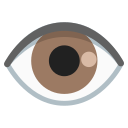


Unicode defines the emoji character or sequence, while each artwork set decides how it is drawn. That is why the same emoji can look different between devices, apps, and design systems.
Helpful tools for discovering, formatting, and converting emojis.
Frequently asked questions about meaning, copying, PNG export, and Unicode data.
The 👁️ Eye emoji represents vision, observation, surveillance, mindfulness, or keeping a watchful eye on something.
Yes. When licensed artwork is available, choose a style and download 1× (128×128), 2× (256×256), 4× (512×512), or 8× (1024×1024) PNG artwork. EmojiMint shows the selected provider, background, and exact pixel dimensions before download.
Yes. The surrounding words, relationship, and platform can change how 👁️ is read, so add text when the intent matters.
👁️ uses the Unicode sequence U+1F441 U+FE0F. Its individual code points are U+1F441, U+FE0F.
👁️ is usually the more general choice. 👀 Eyes is different because pair of wide glancing eyes used for internet drama and curiosity.
Use the copy button on this page to copy 👁️, or select the emoji character directly and copy it from your browser.